On Sunday 8 November, the National Service of Remembrance at the Cenotaph will ‘commemorate the contribution of British and Commonwealth military and civilian servicemen and women’. A short walk away stand the Memorial Gates, whose inscription honours ‘the five million volunteers from the Indian Sub-continent, Africa and the Caribbean’ who fought with Britain in the two world wars.
How Britain should remember the colonial soldiers of its wars is a large question. This post takes one way into it: the word on the stone. ‘Volunteers’ was chosen deliberately, by people with good reason to choose it. But it borrowed a boast of empire, it fits some of the five million better than others, it has no place for those Britain compelled to serve, and it makes their place in British memory depend on proof of loyalty. Decolonising Remembrance begins with asking who, exactly, that word leaves out.
Inclusion has come a long way
Remembrance has worked hard to include these men. In 2018 the Royal British Legion commissioned a khadi poppy, made from the hand-spun cotton of India’s independence movement. In 2021 a special committee of the Commonwealth War Graves Commission found that between 45,000 and 54,000 casualties, mainly Indian, East African, West African, Egyptian and Somali, had been commemorated unequally, and that at least 116,000 more, potentially as many as 350,000, were not commemorated by name or possibly at all. The Commission apologised ‘unreservedly’, and the Defence Secretary apologised in the Commons. This year it put the names of 33,000 Indian soldiers missing from the Basra Memorial on digital panels, recovered 9,909 Punjabi names, and the Legion asks South Asian families to research their relatives’ service.
Inclusion adds names to a story about Britain’s wars. Decolonisation asks on what terms those names are included. The terms are written on the Gates.
The word was chosen as an argument
The campaign for the Gates began in the late 1990s, led by Baroness Flather. The word was there from the start. In a Lords debate in October 1997, Lord Weatherill said the Indian Army of the Second World War had ‘1.5 million men under arms, every single one a volunteer’ (col. 1081). In 1998 Flather told Indian veterans that ‘Everyone of these men was a volunteer’ and that ‘it was the largest volunteer army the world has ever known’ (The Tribune). The Memorial Gates Trust was registered that August. By February 2000 an Early Day Motion spoke of honouring ‘over five million volunteers’, and the Trust described the Gates as honouring those who ‘volunteered to serve’ and the contribution of ‘these men and women and their descendants’ to British society.
Flather later explained her reasoning. ‘Some people think that the Indians joined the armed services because of poverty’, she told the Lords in 2011. ‘I am sure that was a factor, but I am pleased to say that it was not the only factor.’ In 2018 she said that children ‘still do not know why many Indians, Africans and West Indians came to this country. The arrival of many of us is rooted in the war service of our people.’ The Trust’s own discussion of the wording is not public, but read with these statements the word did two jobs. It refused the assumption that colonial soldiers were hired hands, and it grounded their descendants’ place in Britain in a debt freely earned.
It borrowed empire’s boast
The phrase Flather used was not hers alone. ‘The largest volunteer army’ was a wartime boast long before it was a memorial. The Imperial War Museum’s revised captions to its 1942 recruitment photographs, written in 2021 under the Provisional Semantics project, call it a loudly promoted boast that hid the pressure on recruits, and sum up the choice for many as ‘serve or starve’. Recruitment followed the theory of ‘martial races’, and of the more than one million Indians who served overseas in the First World War, about 480,000 came from Punjab, many from indebted smallholdings (Santanu Das). In Tan Tai Yong’s study of colonial Punjab, as a published review summarises it, villages were set recruiting quotas, which created a market in which better-off villages bought recruits from poorer ones.
Africa shows what the word leaves out altogether. In British East Africa, carrier service was made compulsory by the Native Followers Recruitment Ordinance of August 1915. The British forces there used over a million African followers, and G. W. T. Hodges estimates that more than 100,000 died. They are the men the Commission’s 2021 report found most often left unnamed. Whether they are counted in the five million is unclear: the campaign did not publish how it reached the figure, and an inscription to those who ‘fought’ reads as a tribute to soldiers. Either way, a memorial organised around volunteering has no category for them. The Caribbean shows the hierarchy from another side. The men of the British West Indies Regiment did volunteer, yet the War Office largely kept them to labour, denied them a 1918 pay rise because they were classed as ‘natives’, and granted it only after they petitioned. Africa sits uneasily in the campaign’s own record too: a 2001 government answer described the Gates as commemorating ‘the peoples of the Indian sub-continent and the Caribbean’.
Even the record was made by empire
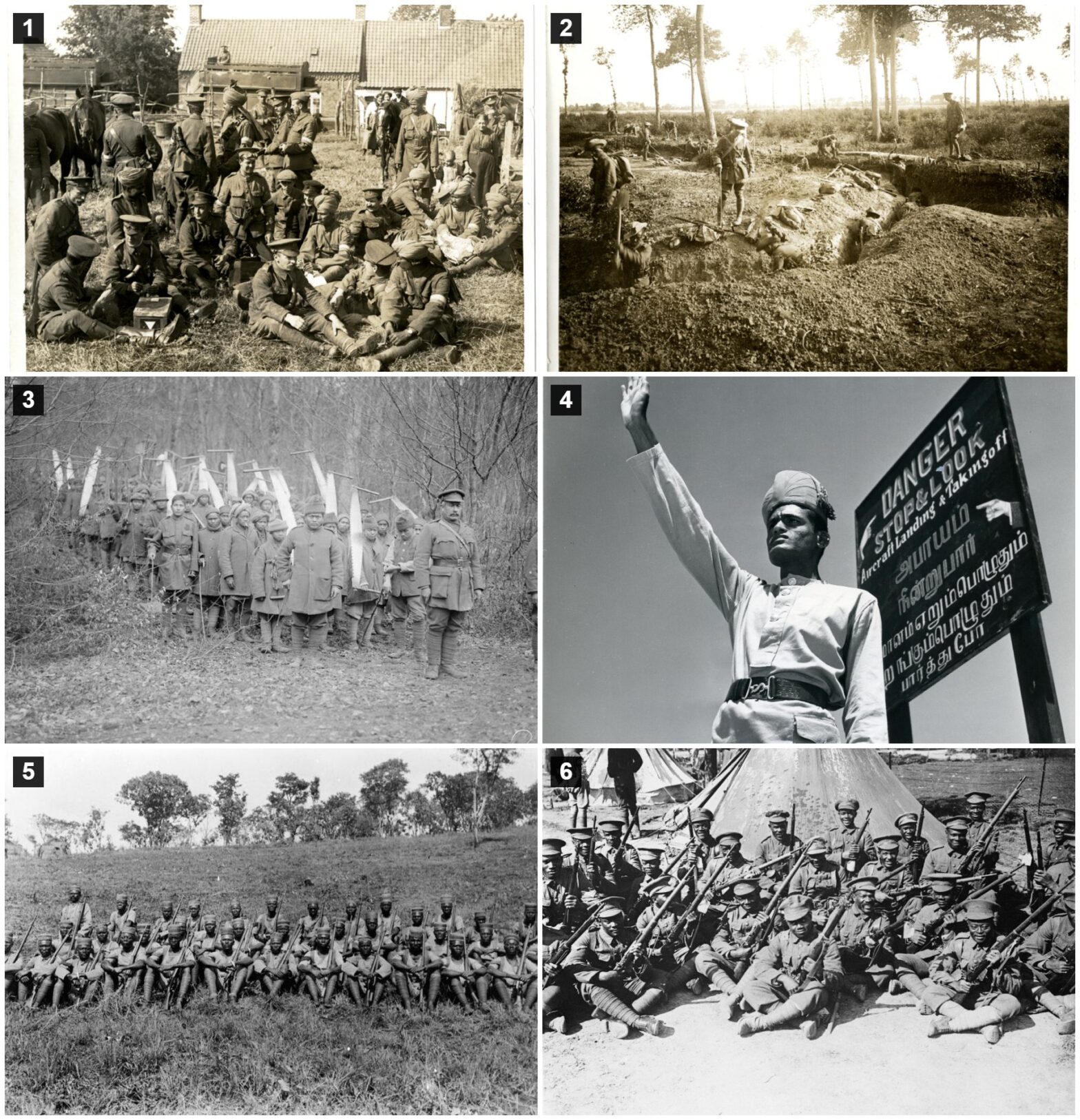
Much of what survives of these men’s own words reaches us through the empire’s files. The letters of Indian soldiers in France reach us as translated extracts in the censor’s reports at the British Library. They knew they were read. In May 1915 Khan Muhammad of the 40th Pathans wrote from hospital in Brighton of an expenditure ‘too great for words’ of ‘black and red pepper’, a coded reference to Indian and British troops. Most of the photographs above were made the same way: the Imperial War Museum’s are official war photographs, and Girdwood was allowed to follow Indian units in France after he promised his pictures for propaganda. A memorial that calls every one of them a volunteer speaks for them more confidently than the archive allows.
From volunteers to immigrants
The loyalty the word records was soon tested against the law. The Windrush Lessons Learned Review found that half of those who arrived on the Empire Windrush in 1948 ‘had been among the 10,000 Caribbean servicemen who had come to join the British forces in World War Two’, and that migrants of that period ‘arrived as citizens of the UK and Colonies, with equal rights to live in the UK’. Citizens of India and Pakistan held a different status: under the British Nationality Act 1948 they were Commonwealth citizens with ‘the status of a British subject’. Neither group was subject to immigration control until 1 July 1962, when, in the Home Office’s own account, Commonwealth citizens ‘became subject to immigration control’. Decades later, people of the Windrush generation were wrongly treated as unlawfully present, and the review found ‘an institutional ignorance and thoughtlessness towards the issue of race’.
This is where the word’s logic matters now. A memory that admits colonial soldiers because they volunteered makes belonging a reward for proven loyalty. The conscripted carrier and the recruit who enlisted to eat cannot pass that test. Current immigration policy offers an analogy, not a claim of historical influence: the Government’s newly announced settlement reforms and the memorial’s language both make demonstrated contribution the ground of belonging. On 2 November the Home Secretary announced that, once the Immigration Rules are changed, the default wait for settlement will rise from five years to ten, and that ‘how long someone waits will now depend on their contribution and character’. Service in uniform still counts: members of the armed forces ‘will keep their current pathways’. John Siblon has shown how memorials after 1918 cast Asian troops as loyal helpers in a ‘white man’s war’, and Nirmal Puwar and Sanjay Sharma warn that belonging is too often tied to ‘who is seen to have fought and spilt their blood for the nation’. The word ‘volunteers’ carries the loyal helper into the twenty-first century, on a memorial built to honour him.
The objection, and the answer
A historian of the colonial armies might put the strongest objection this way. The Gates were built to honour a neglected group, not to tell the whole history of imperial labour. A memorial to volunteers need not commemorate conscripted carriers, and its inscription does not misdescribe the men it was meant to honour. Many of them did volunteer, and their families are proud of it.
Much of that is right, and the campaign deserves full credit. It won a national memorial that, in Flather’s words, was ‘built not by the Government but by people giving money’, and the word answered a real slur. But the categories a memorial chooses are themselves historical choices. When a prominent national monument to colonial service makes voluntary loyalty its organising principle, it narrows memory even when its purpose is inclusive. The dignity of these men does not depend on proving that they chose freely. A decolonised Remembrance would honour the volunteer, the recruit who enlisted to eat and the carrier who had no choice, and would make none of them earn his place. The Gates need no new stone. The Memorial Gates Council and the Royal British Legion could say, in their materials and at the site, that these men served: some as volunteers, some under pressure or compulsion, all under empire.
The archives to tell that fuller story are open. The Commission’s guidance explains how to search its records by country of service; the censor’s reports are in the India Office Records at the British Library (IOR/L/MIL/5/825 to 828); and The National Archives holds war diaries (research guide) and the West Indian petitions. When Britain falls silent on 8 November, the stone on Constitution Hill will still say ‘volunteers’. Remembering who they were, exactly, means remembering how each of them came to serve.
How to cite this post
Bin Mohd, S.A. (2026) ‘Decolonising Remembrance means honouring colonial service, not just voluntary loyalty’, Sheikh Abbas Bin Mohd, 3 November 2026. Available at: https://abbasbinmohd.com/decolonising-remembrance-colonial-service/